← Back to home
The architecture

Five questions,
enforced.

Every action any AI takes inside SpeyAI answers five governance questions. Not by policy document: by the structure the work runs inside. This page walks all five.

The governed production line
Human-led or autonomousIn your cloud
Inputa goal · a Brief
The orgroles · one chain of command
01Plan
02Build
03Review
04Ship
Governed at every step
touchspendapproveshiplog
Humansigns the merge
Outputshipped work · code · pipelines · data platforms
The anatomy

A seat, defined.

Every seat is defined before it is given any work. What follows is what the architecture holds it to, question by question.

An agent seat is not a prompt. It is a defined position: a persona and the doctrine it holds, the skills it is competent to be handed, and a spend cap it cannot exceed. Around it, the architecture holds the rest: one global tools suite the stage draws from per invocation, one sacred-path policy every seat is refused, and a shared bank of gates that reviews what it produces.

The five questions below are answered before any work is dispatched: some at the seat’s own definition, the rest by the architecture it runs inside. A seat cannot widen either one, and no instruction reaching it at runtime can either.

One seat, up close

Senior Backend Engineer

Graduated · Full Pipeline
Persona
312linesDirect, terse, tests first.
Doctrine · Earned in Production41earned rules
  • Never opens a PR on a red baseline; reads the last run on the target branch first.
  • Splits schema changes from behavior changes; one merge, one risk.
  • Treats a flaky test as a defect, not a retry.
Skills
APIs · migrations · queue design
Tools
58in the suite · deploy: nonerepo.read · repo.write · ci.run · db.migrate (staging only)One global tools suite. The stage attaches what a step needs, per invocation.
Caps
$5.00 per task · the breaker trips at the cap · escalation goes to a person
Sacred
23paths · one policy, every seatdeploy/** · billing/** · secrets/**Declared once in your configuration. The seat gets its touch scope per task.
Review
The shared gate bank: Security, QA, and Code Quality. No seat reviews its own work.

A job description, not a prompt. Hundreds of lines per seat, earned in production, ratified by a person.

Frontend Engineer287 lines · 34 rules
Platform Engineer356 lines · 38 rules
Data Engineer298 lines · 31 rules
Integrations Engineer341 lines · 44 rules
Database Administrator372 lines · 27 rules
Security Reviewer418 lines · 22 rules
Compliance Analyst393 lines · 18 rules
Access Reviewer264 lines · 16 rules
Privacy Reviewer307 lines · 19 rules
Threat Modeller384 lines · 21 rules
QA Lead329 lines · 29 rules
Test Engineer276 lines · 33 rules
Code Reviewer361 lines · 24 rules
Release Manager338 lines · 36 rules
Performance Analyst292 lines · 26 rules
Product Manager347 lines · 17 rules
Business Analyst281 lines · 14 rules
Solution Architect402 lines · 23 rules
Technical Writer258 lines · 12 rules
Support Lead313 lines · 20 rules
Site Reliability Engineer441 lines · 39 rules
Incident Responder396 lines · 32 rules
Observability Engineer351 lines · 35 rules
Cost Analyst269 lines · 15 rules
Change Manager322 lines · 18 rules
Migration Engineer368 lines · 30 rules
API Designer294 lines · 25 rules
Build Engineer333 lines · 37 rules
Schema Owner379 lines · 28 rules
Records Custodian253 lines · 13 rules
Policy Author316 lines · 16 rules
Vendor Reviewer271 lines · 14 rules
Audit Liaison344 lines · 19 rules
Accessibility Reviewer288 lines · 21 rules
Regression Analyst359 lines · 27 rules
Fixture Curator262 lines · 23 rules
Design Reviewer297 lines · 18 rules
Localization Editor254 lines · 12 rules
Research Analyst326 lines · 15 rules
Onboarding Lead283 lines · 17 rules
Billing Analyst309 lines · 16 rules
Pricing Analyst274 lines · 13 rules
Capacity Planner337 lines · 22 rules
Backup Steward363 lines · 26 rules
Network Engineer391 lines · 31 rules
Runbook Author267 lines · 14 rules
On-Call Scheduler279 lines · 19 rules
Query Optimizer318 lines · 24 rules
Cache Engineer286 lines · 29 rules
Data Steward353 lines · 22 rules
Dependency Auditor348 lines · 17 rules
Key Custodian366 lines · 12 rules
Contract Tester273 lines · 31 rules
Content Strategist304 lines · 13 rules
Requirements Analyst331 lines · 15 rules
Field Enablement Lead268 lines · 14 rules
Log Analyst291 lines · 20 rules
Rollout Engineer374 lines · 33 rules
Escalation Lead259 lines · 16 rules
Chaos Engineer407 lines · 36 rules
Every seat is defined exactly this way.
The lifecycle

A goal becomes signed, shipped work.

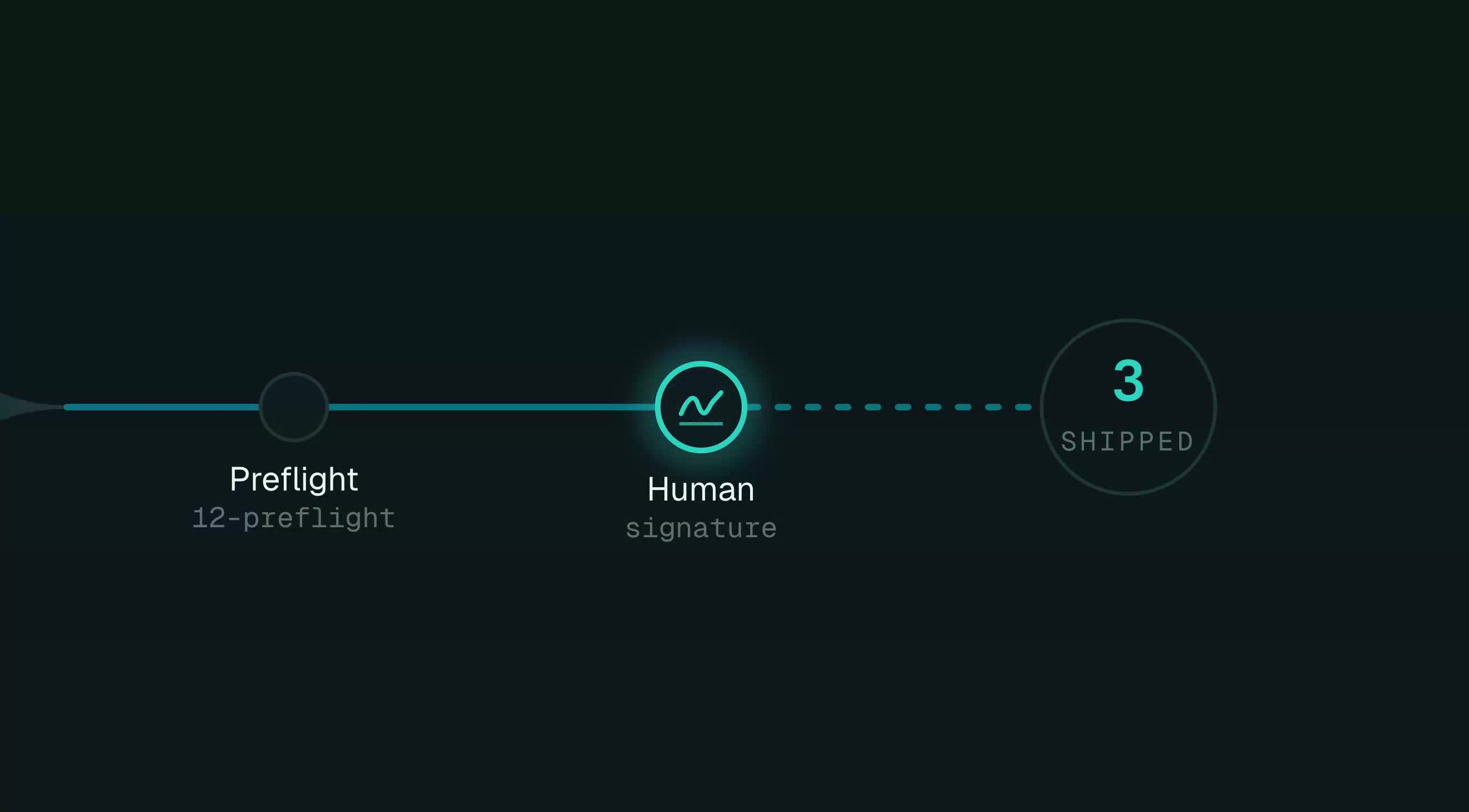
The machine does the work and stops itself at every gate. You hold two: you approve the scope before anything starts, and you sign the merge before anything ships. That holds until you graduate the instance, and code still comes to you afterwards.

The loop
  1. 01
    Goal inin
    A Brief enters, from you or pulled from Jira.
  2. 02
    Feature specmachine
    Scope, acceptance criteria and a cost band, written first.
  3. 03
    Approve scopehuman
    You ratify the scope before any work starts.
  4. 04
    Architecture reviewmachine
    The approach is checked before a line is written.
  5. 05
    Buildmachine
    Agent seats write the code.
  6. 06
    Security reviewmachine
    The change is read for security flaws.
  7. 07
    QA and testsmachine
    A QA seat validates it against the acceptance criteria.
  8. 08
    Independent reviewmachine
    A different seat reviews the diff, never the one that wrote it.
  9. 09
    Documentationmachine
    The docs are updated with the change.
  10. 10
    Preflightmachine
    Final checks before it leaves the org.
  11. 11
    Open a pull requestmachine
    A pull request is opened against your own repo.
  12. 12
    Sign and mergehuman
    Your signature goes on the record, then it merges.
  13. 13
    Shipped to productionout
    Merged and deployed, with a forensic receipt.
Q1 · What can it touch?

What can it touch?

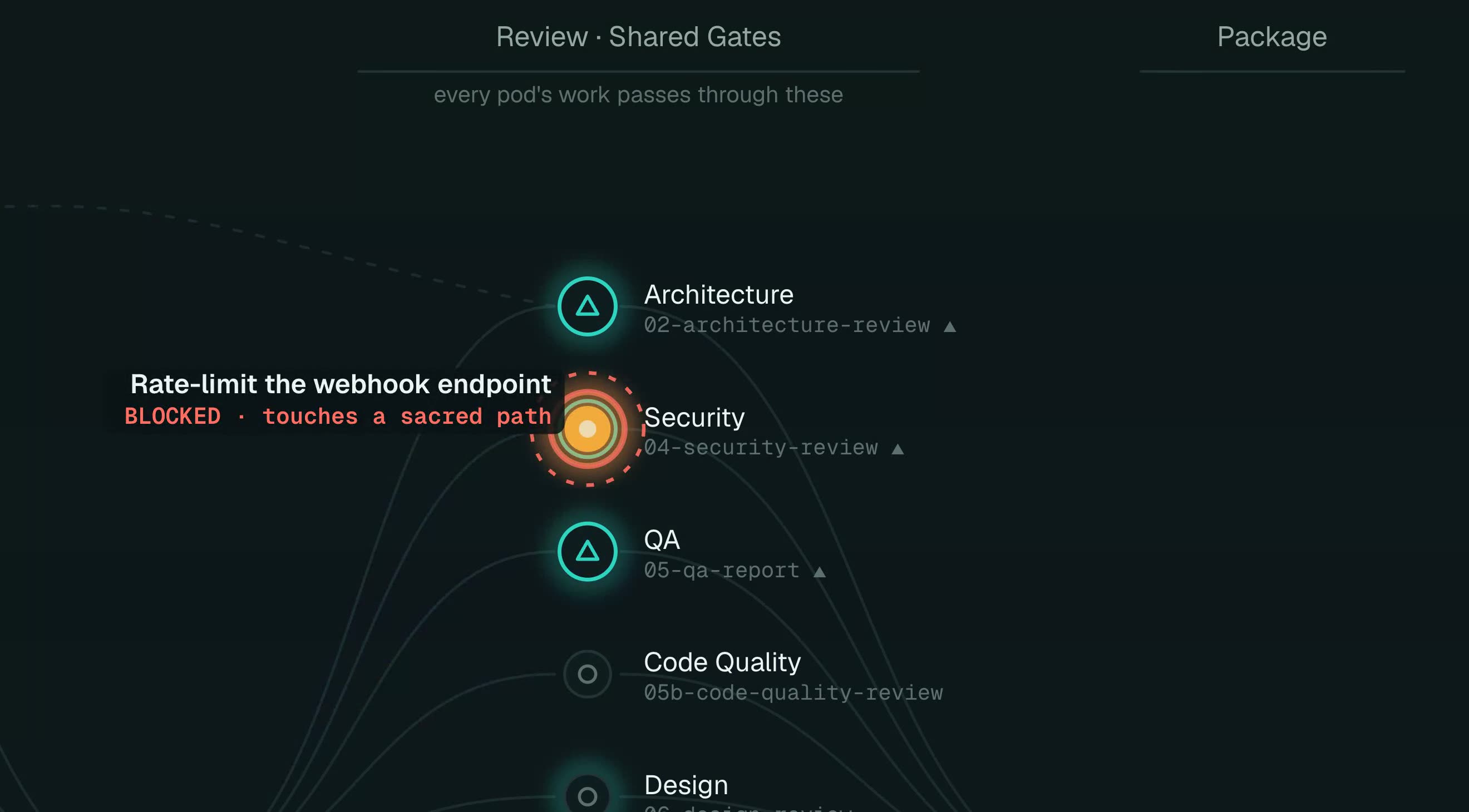
A seat is granted a path list, never a repository. Sacred paths are declared once, in your configuration, and enforced at the gate: a change that reaches outside them does not become a pull request.

Tools come from one suite, and the stage attaches only what a step needs, per invocation. A seat that writes documentation is never handed a deploy tool, and nothing it reads during a task can hand it one.

The gate bank runs on the diff, not on stated intent. It reads what the change actually touched, and out-of-bounds work stops inside the org.

Gate bank · path check
A change held at a gate under a blocked-for-sacred-path refusal, then passing the same gate after it is rebuilt.
Seat
backend-engineer
Granted
services/** · tests/**
Touched
deploy/production.yaml
Result
REFUSED · out of granted paths
An out-of-bounds change stops at the gate bank, before a pull request exists.
Q2 · What can it spend?

What can it spend?

Every seat carries a cap on what it can spend in a day, and no single call can exceed a hard per-call ceiling. Above both sits an org-wide daily halt, because caps that bind one seat at a time do not bound the org’s total.

All three are checked before the model is called. A cap refusal is a refusal: the task stops, the reason it stopped is recorded, and nobody is handed a warning they can dismiss.

You set the caps before the org is given any authority at all, and raising one is a decision a person makes, on the record. Every call is then written down at micro-dollar precision, against the seat that made it and the task it belonged to.

Cost meter · cap check
A spend meter stopped at thirty dollars against a thirty dollar daily cap, with the refusal shown under it.
Checked
before the model is called
Caps
per seat, per day · per call · org-wide
Ledgered
micro-USD, per seat and task
At Cap
REFUSED · task stops
Spend is checked before the call and written down after it. The cap is a stop, not a threshold.
Q3 · Who approves?

Who approves?

The org proposes. A person ratifies. That order does not invert, and there is no configuration that inverts it.

Roles sit under one chain of command, and nothing self-approves. The seat that wrote a change is never the seat that reviews it, and no seat is ever the human.

An approval is a named person against a named decision, held on the record with the work it authorised.

Chain of command · ratification
A drafted proposal returned as ratified, signed by a named human against a named decision.
Proposed By
the seat that did the work
Reviewed By
a different seat, always
Self-Approval
not available
Ratified By
a named human
Authority moves one way. Nothing in the org can approve its own work.
Q4 · What ships?

What ships?

Work crosses a review bank before it can leave the org: the approach, the security read, quality against the acceptance criteria, an independent read of the diff, the docs, and preflight.

Then it stops at a person. A pull request opens against your own repository, and it merges when a human signs it. Your signature is what ships the work.

A new deployment starts in probation: the org reads, drafts, and proposes only, until you graduate it.

Signature gate · merge
Work held at the signature gate, and the shipped count ticking up once a human has signed it.
Drag to explore →
Reviews
architecture · security · QA · diff · docs
Author
never the reviewer
Pull Request
against your own repository
Merged By
a human signature
The review bank is machine work. The last gate is not.
Q5 · What got logged?

What got logged?

Every action lands on the record as it happens: the seat that took it, the task it belonged to, the tools it called, the money it spent, each gate result, and the signature that released it.

Click any shipped item and walk its full history back to the goal that started it. The question an auditor asks is answered by opening the item, not by reconstructing it.

The record is written to your database, on your own infrastructure. Nothing about the run has to leave it.

The roll-up

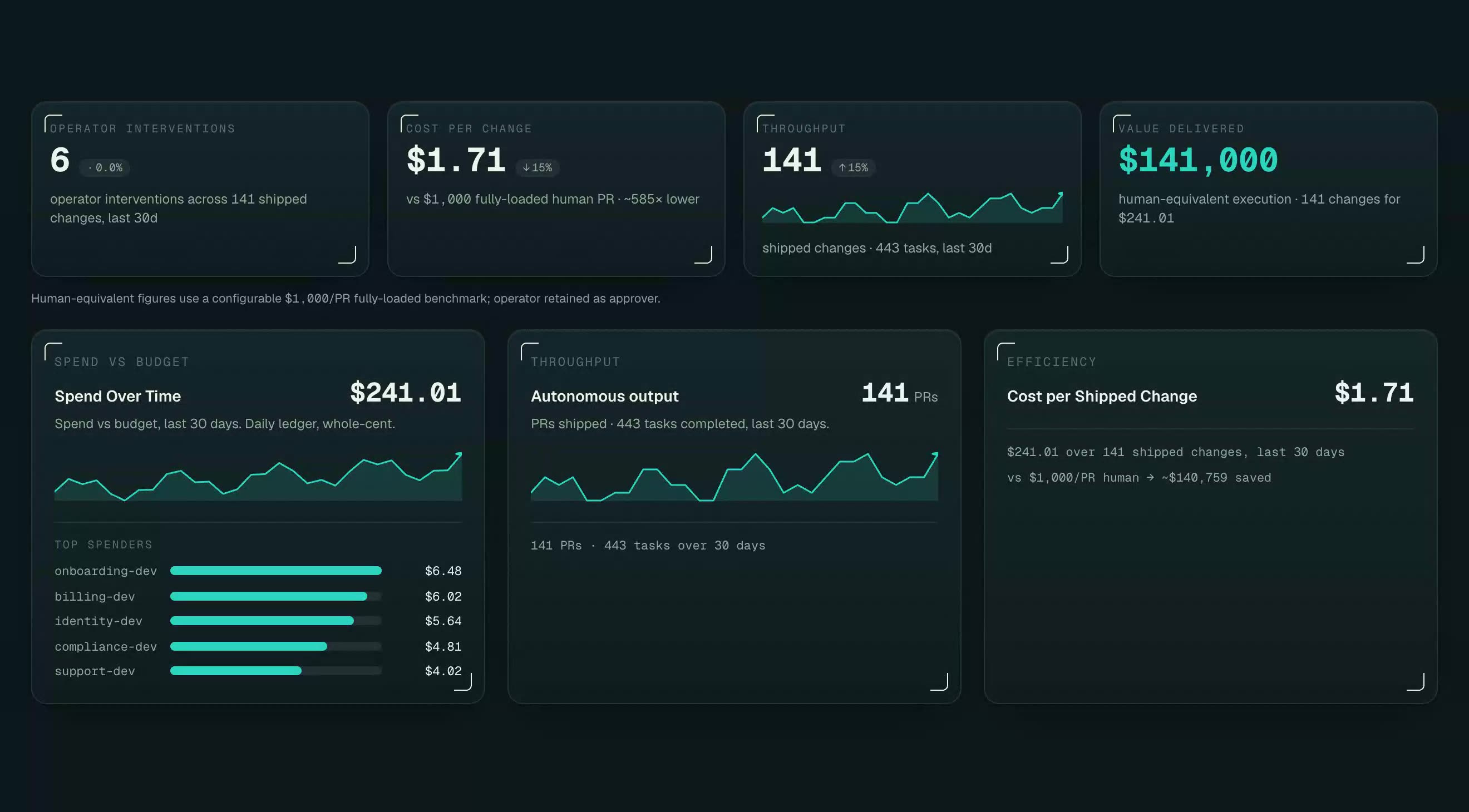
The record becomes the executive report.

Nothing is re-keyed. Every figure a board asks for is already on the record, because a governed run writes it as it happens.

Reporting · the thirty-day window
An executive report standing complete over a thirty-day window, assembled from the record a governed run wrote.
Assembled From
the same audit record
Window
rolling thirty days
Reported
interventions · cost per change · throughput
Manual Entry
none
The report is a read of the record, not a second system anyone has to maintain.
The whole of it

Five agents or five thousand…
one chain of command.

Same five questions, same answers, at any size. The architecture is what makes that true.

Request a briefingWhere it runsRead the research