← Back to home
The pilot

Sixty days, on your own work.

The first move is not a license. SpeyAI installs the governed org in your environment, white glove, and runs it on your actual backlog for sixty days, in probation from day one. You watch the gates hold on your own stack, with your own approvers, at your own pace.

The fee is fixed and published, and if you acquire the license it is credited back in full. The pilot is priced risk, not sunk cost: convert and it cost nothing; walk away and the exposure was bounded and you keep the record it wrote.

The offer

One number, stated up front.

$25,000
fixed fee for the full 60-day engagement: white-glove install and a live run on your own backlog
Credited in full toward the first-year license on conversion

No per-seat math, no usage tiers, no quote call required to learn the number. A buyer who has to book a meeting to learn a price reads the price as negotiable and the offer as vague. This one is neither. It is the same discipline the product applies to agent spend, applied to how the product is bought.

The run

What the sixty days actually are.

A sequence, not a subscription. The order is the content. Nothing gets authority before your team has ratified what it may touch, and nothing ships without the gates the product exists to enforce.

01
Install, in your estate Days 1–5

SpeyAI stands the instance up on your host and your Postgres, pointed at your repositories and your model account. Nothing runs on our infrastructure, and no code or data leaves your building.

02
The wizard, run jointly Week 1

The org reads your repositories and drafts its own configuration. Sizing, the sacred paths it may never touch, rules, connections, your names. Your team reviews and ratifies every line before anything runs. Nothing configures itself into authority.

03
Probation, on real work Weeks 2–8

The org works your actual backlog, not a demo environment. The full pipeline runs and every decision is recorded, and every merge is held for a human until you graduate it.

04
The record, accumulating Throughout

From day one the audit trail writes itself as a by-product of the work. What was touched, what was spent, who approved, what shipped. By week two your reviewers are reading evidence, not marketing.

05
The graduation review Day 60

At the end of the run we walk the evidence with the people who have to sign. What shipped, what the gates caught, and the cost per shipped change from your own instance ledger. The decision is made on your numbers, in your building.

And the run is a channel, not a ticket queue. A pilot works directly with the team building the platform, and what your run needs shapes what ships.

Day 60

What you leave with, either way.

The shipped work

Reviewed, merged changes in your own repositories. They are yours regardless of the decision, because they were never anywhere else.

The record

The full audit trail the run wrote as it worked. What was touched, what was spent, who approved, what shipped. Evidence your reviewers can query, not a slide about evidence.

The evidence pack

The graduation review's working set. What the gates caught, throughput, and cost per shipped change from your own instance ledger, walked with the people who have to sign.

Not the first

You would not be the first implementation.

The org you would be piloting has run in production since April 2026, building and shipping the platform it runs on, through the same gates it would install for you. The proof is on the home page and the architecture is public; the pilot exists so the next thing you evaluate is the run on your own stack, not our telling of it.

1,486
pull requests merged through the gates, across every platform the org has shipped
GitHub API · measured 2026-08-26
The org, running
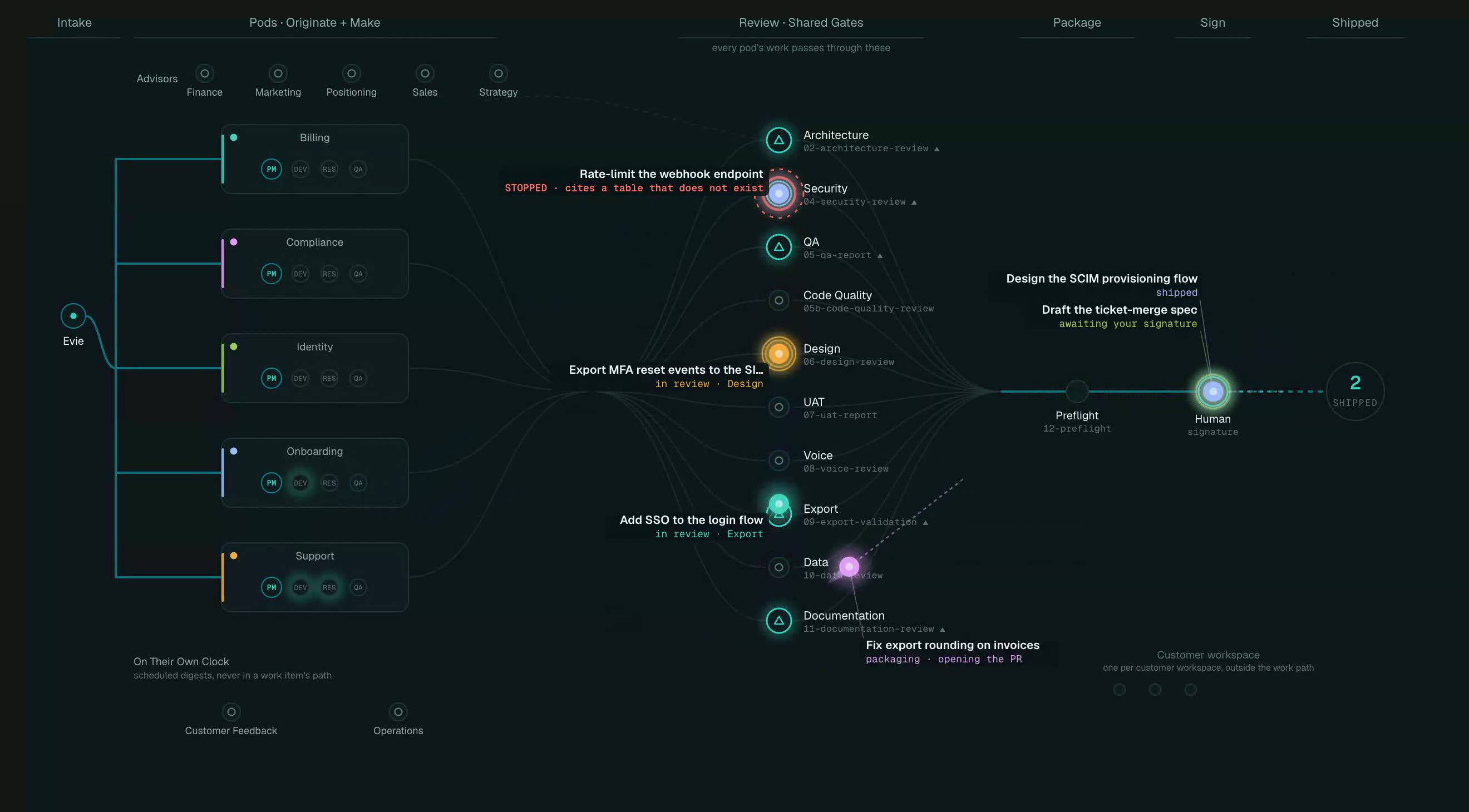
The Governed Line: functional pods over one shared review bank, one change held at the gate that refused it, ending in a human signature and a shipped change.
Drag to explore →
The HeaderThe whole org, and the part of it working right now.
The TopThe chief of staff. The one seat that talks to you. A described outcome goes in; a scoped, costed brief comes out.
The PodsFunctional pods do the work. Onboarding, billing, compliance, whatever your org runs. Each pod makes its own work.
The BankOne shared review bank. Every change crosses the same chapters, architecture and security first. The seat that writes is never the seat that reviews.
The SignatureA human signs the merge. Nothing reaches production without it while the instance is on probation.
The LinesWork moving down the line. Each hop is a handoff that cleared a gate.
The ShipShipped, on the right. Reviewed, signed, merged.
Questions

The terms, asked plainly.

What does the pilot cost?

A fixed fee of $25,000 for the full 60-day engagement, stated up front. No per-seat math, no usage tiers, and no quote call required to learn the number. Model usage runs on your own provider account, so that spend is yours, visible, and capped by the same spend gates the product enforces.

What does "credited toward the license" mean?

If you acquire a license at the end of the pilot, the full $25,000 is credited toward the first-year license fee. Convert and the pilot cost you nothing. Walk away and your exposure was the fee and a bounded install, and you keep the audit trail the run produced.

Where does it run during the pilot?

In your environment, exactly as a licensed deployment would. Your host, your Postgres, your version control, your model account. The pilot is not a sandbox on our side, because the point of the pilot is to watch the governance layer hold on your own stack.

Is this a demo, or real work?

Real work. The org runs on your actual backlog in probation mode. The full pipeline, full decision records, every merge held for a human until you graduate it. The evaluation an enterprise would normally build a proof-of-concept environment for is a first-class lifecycle stage of the production install.

What is not included in the fixed fee?

Custom feature development, certification of models outside the certified set, and integrations beyond the shipped connection set. The scope boundary is what makes a published fixed price honest, so it is stated rather than discovered.

Who does the work on our side?

One technical lead, part-time, as the operator, ratifying briefs and clearing the decisions that need a human. Your platform team is involved at install and at the graduation review. There is no staffed bench and no resident consultants.

Start

Name the backlog. We bring the org.

Tell us the repository that matters and the outcome you want from the first sixty days. The response is a prepared briefing and a proposed install plan, not a sequence of discovery calls.